Armstrong Team
USMNT Training Workouts: How the USA Men's Soccer Team Prepares
Inside the U.S. men''s national soccer team training program — gym sessions, speed work, tactical drills, and recovery at elite camps. What players do and what amateurs can use.
The U.S. men's national soccer team (USMNT) has modernized fast. Gone are the days when American players looked fit but lacked elite speed and strength. Today's squad trains inside high-performance centers, uses GPS and force-plate data, and mirrors the physical standards of top European federations.
Whether you call it soccer or football, this guide explains how USMNT players actually train — gym, field, and recovery — and how to build a similar week on your own schedule.
How USMNT Training Camps Are Structured
International windows last roughly 7–14 days. U.S. Soccer compresses work into clear blocks:
- Medical and fitness screening — movement quality, hamstring strength, body comp
- On-field tactical install — pressing, shape, set pieces
- Gym and speed sessions — position-specific loads
- Recovery and travel management — especially for Europe-based players
Double sessions happen in heavy prep windows: morning tactical, afternoon gym or conditioning.
Gym Work: What USMNT Players Do
The USMNT strength staff emphasizes robust athletes who sprint repeatedly — not linebackers who cannot move.
Lower body (foundation)
- Trap-bar deadlifts and RDLs — posterior chain for sprinting and hamstring health
- Split squats and lunges — single-leg strength for cuts and landings
- Squat variations — back squat, front squat, or goblet depending on player history
- Nordic hamstring curls — injury-prevention standard across modern soccer
Upper body (functional, not cosmetic)
- Rows and pull-ups — shoulder health for throw-ins and duels
- Push press and landmine presses — power without bench-pressing ego
- Core anti-rotation — pallof press, carries, planks
Power and plyometrics
- Box jumps, hurdle hops, broad jumps
- Med-ball slams and throws
- Resisted sprint drills with sleds or bands
Sessions run 45–75 minutes. Loads are periodized — heavier in off-season camps, lighter before matches.
Field Conditioning: Speed and Repeat Sprint Ability
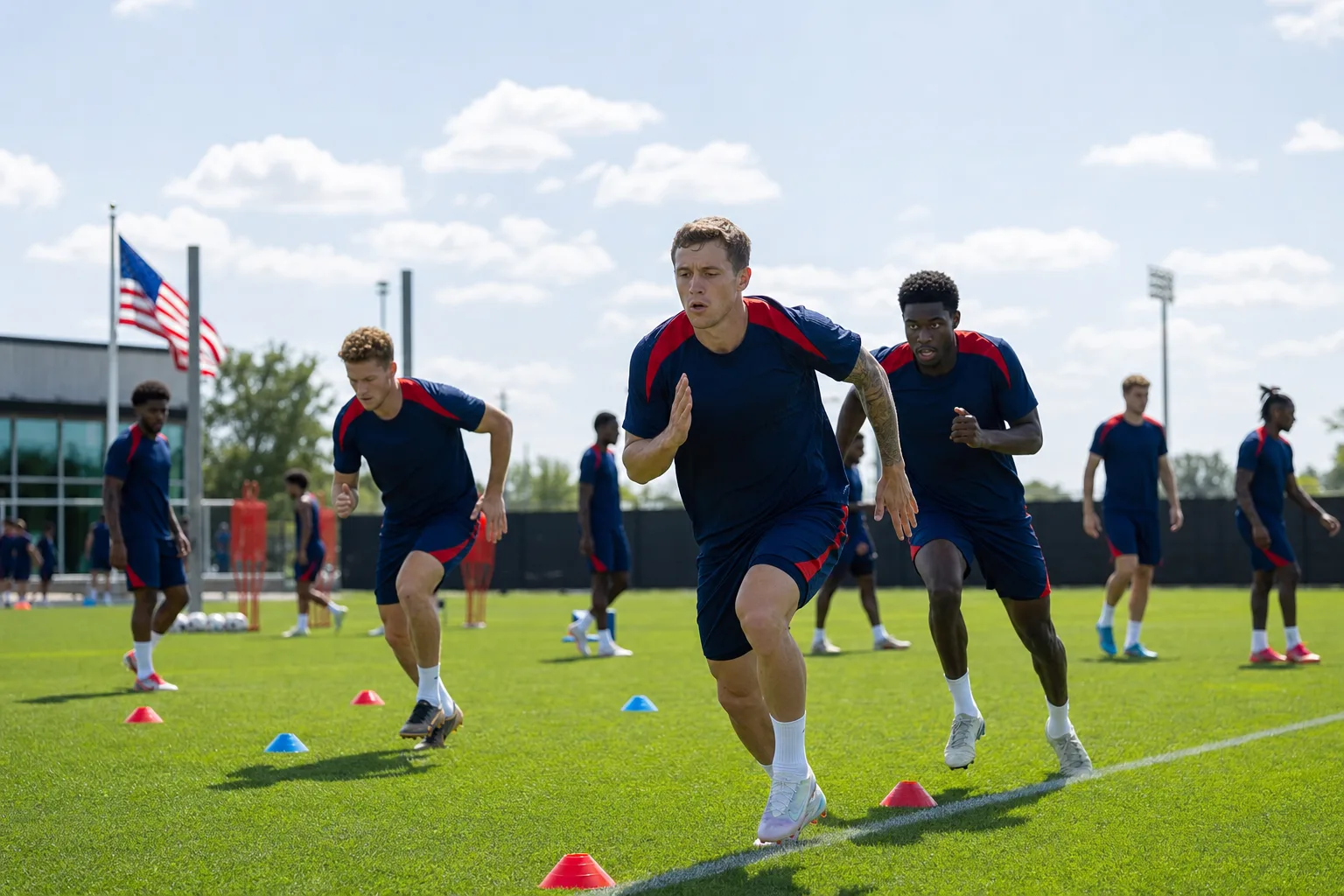
American soccer's biggest upgrade is athleticism without the ball. USMNT camps regularly include:
| Session type | Example work |
|---|---|
| Max velocity | Flying 20s–40s, full recovery between reps |
| Repeat sprint ability | 6–10 × 30m with 20–30s rest |
| Agility | Cone shuttles, curved runs, defensive footwork |
| Tactical runs | Pressing triggers tied to coach cues |
| Small-sided games | 4v4 to 7v7, touch limits, high heart rate |
GPS targets cap total high-speed running so players arrive match-fresh, not fried from camp.
Position-Specific Differences
Not every USMNT player runs the same week:
- Wingers and fullbacks — more max-speed work, lateral agility
- Center backs — jumping, neck and trunk strength for aerial duels
- Midfielders — highest total distance; aerobic repeatability
- Strikers — acceleration, finishing under fatigue, hold-up strength
- Goalkeepers — explosive lateral power, shoulder prehab, less field running
The gym is shared; running volumes are individualized.
Recovery and Sports Science
U.S. Soccer's partnership with IMG Academy, StubHub Center, and other centers gave the program:
- Cold tubs and contrast therapy
- Normatec-style compression
- Daily soft-tissue work
- Sleep education — travel across time zones is planned, not ignored
- Hydration and electrolyte protocols in heat camps (Florida, Texas, summer qualifiers)
Players flying in from the Premier League, Bundesliga, and MLS get adjusted sessions — partial participation beats pulling a hamstring on day two.
Nutrition at Camp (Overview)
Team dining is structured: lean protein, carb timing around sessions, vegetables, hydration stations. Detailed body-fat and macro targets are covered in our companion piece on USMNT body composition and diet.
Sample USMNT-Inspired Microcycle
| Day | Focus |
|---|---|
| Monday | Gym — lower body strength + Nordics |
| Tuesday | Field — tactical + repeat sprints |
| Wednesday | Gym — upper pull + core / or active recovery swim |
| Thursday | Field — small-sided games, pressing work |
| Friday | Gym — power plyos (low volume) + mobility |
| Saturday | Match or scrimmage |
| Sunday | Rest, stretch, light walk |
Amateurs: two gym days, one speed day, one sport practice beats copying a full national-team volume.
What Changed in the Modern USMNT Era
Several shifts explain faster, stronger American players:
- Year-round strength staff at clubs and federation level
- Earlier specialization in speed and technical academies (MLS NEXT, DA pipeline)
- European minutes — core squad players in top leagues face higher daily loads
- Data culture — if GPS says you hit your sprint budget, intensity stops
The USMNT no longer treats fitness as a preseason panic — it is baked into the weekly rhythm.
Frequently Asked Questions
How fit is the USMNT compared to Europe?
The gap has narrowed. Top U.S. internationals in European leagues meet the same club S&C standards as teammates; federation camps align with UEFA-style periodization.
Do USMNT players bench press heavy?
Some do, but trap-bar pulls, squats, and single-leg work matter more for soccer transfer. Max strength is tracked; bodybuilding is not the goal.
How can youth players train like the USMNT?
Master sprint mechanics, single-leg strength, and hamstring durability before chasing adult volumes. Sleep and nutrition count as training at every age.
Is American football training the same as USMNT soccer training?
No. This article covers U.S. men's national soccer. American football uses different size, collision, and strength profiles — though both sports value speed and structured lifting.
Bottom Line
USMNT training combines European-style periodization with American athletic development — heavy legs, smart sprints, GPS-managed loads, and recovery you do not skip.
Track gym numbers and conditioning in Armstrong so your progress is visible week to week — the same habit elite camps are built on.
Related guides
Best Gyms in Miami (2026) — Beach, Brickell & Budget Compared
Ranked guide to the 20 best gyms in Miami — Equinox, Life Time, Crunch, Planet Fitness, and boutique studios. Prices, neighbourhoods, and who each club suits.
Read article →Best Gyms in Manchester (2026) — Prices Compared Across the City
Compare the 20 best gyms in Manchester — PureGym, The Gym Group, JD Gyms, David Lloyd, and boutique strength spots. Prices, tram access, and who each club suits.
Read article →Best Gyms in Edinburgh (2026) — Prices, Old Town & Leith Compared
Compare the 20 best gyms in Edinburgh — PureGym, The Gym Group, Edinburgh Leisure, Bannatyne, and boutique strength studios. Prices and who each club suits.
Read article →